Showing posts with label Review. Show all posts

Alien Arena 2011 Released - Overview & Screenshots

    Alien Arena 7.50 (a.k.a. Alien Arena 2011) was released yesterday and it comes with several new notable features regarding the physics engine, as well as two new maps, updated player and skins models, new music for various maps, revamped in-game IRC client, as well as several bug fixes and improvements.


    Alien Arena is a free, open-source first-person shooter for Linux, Windows and Mac which takes place in retro science-fiction environments, with a fast pace, support for single player and multiplayer games, a host of interesting game modes besides the usual DM or CTF, like Team Core Assault, Deathball, Instagib, Vampire, Regeneration, Low Gravity.


    Here are the main new features for this release:
    - Ragdoll physics using the Open Dynamics Physics Engine
    - two brand new maps, Total Annihilation and Neptune's Lost City
    - rewritten in-game IRC client
    - updated player and skin models
    - fixed LOD meshes for all player models
    - faster particle rendering
    - True Type Font support
    - new music for various maps
    - various bug fixes, code cleanups and improvements


    New map - Neptune


    To compile the Alien Arena source in Debian/Ubuntu, type in a terminal:

    sudo apt-get build-dep alien-arena
    sudo apt-get install libode-dev

    ./configure

    make

    sudo make install


    Important notices
    The executable is called crx, and it is located in the /usr/local/bin/ directory (if no other path was specified at the command-line to the configure script). To run it type crx in a terminal or press Alt+F2 and type crx followed by Enter in the run box that appears.

    The configuration directory for Alien Arena is located in ~/.codered/, where ~ is your home directory (e.g. /home/USER/.codered).

    Source URL: https://ashesgarrett.blogspot.com/search/label/Review
    Visit ashes garrett for Daily Updated Hairstyles Collection

2 Linux Screencasting Applications

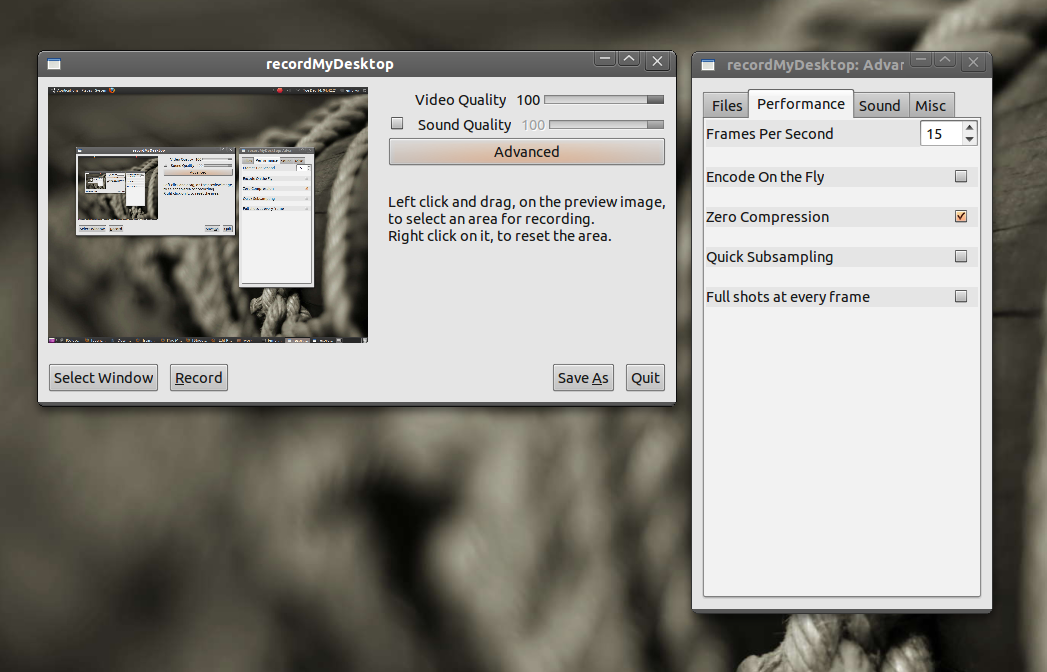
    recordMyDesktop - This is a powerful command-line screencasting application which uses open formats to save the obtaining video (Ogg Theora for video and Ogg Vorbis for audio). recordMyDesktop also provides GTK and Qt frontends, for both GNOME and KDE (the Qt version is not included in Ubuntu's repositories, but it can be downloaded from SourceForge).

    However, recordMyDesktop seems unable to record sound, the program hanging there so I had to kill it manually. It will successfully record 3D in Ubuntu if 3D effects are enabled. At start I though it was a video related issue, so I looked in the man page and the bugs section specifies that it will not work unless the --full-shots parameter is specified in the command-line. I did it and no result. I also tried changing the --fps option to 8 fps but still no result, with the program hanging there so I had to kill it manually. I used Ubuntu 10.10 with the version of recordMyDesktop which comes in the repositories (which seems to be unmaintained since 2009). However, I gave it a try by disabling sound recording, and it turned out that was the issue. After I googled it, I also tried to change the sound driver to hw:0,0 but again, no results, this time I got an I/O error. Should this have something with the sound driver? Maybe someone knows a workaround for this.

    recordMyDesktop


    To use it, just type recordmydesktop in a terminal and hit Ctrl+C when done, then wait for the file to be encoded. By default it will save the video in a file called out.ogv, in the current working directory. Options like --fps, --no-cursor, --on-the-fly-encoding or the output filename can also be specified. For example:

    recordmydesktop --no-sound --fps 8 --on-the-fly-encoding myfile.ogv

    Will encode a video called myfile.ogv of the entire screen, with no sound, using on the fly encoding and a framerate of 8 fps.

    To install it in Ubuntu, type in a terminal: sudo apt-get install recordmydesktop

    Or, for the graphical frontend: sudo apt-get install gtk-recordmydesktop

    The graphical frontend offers a nice graphical configuration window, so some may be more comfortable with this one.

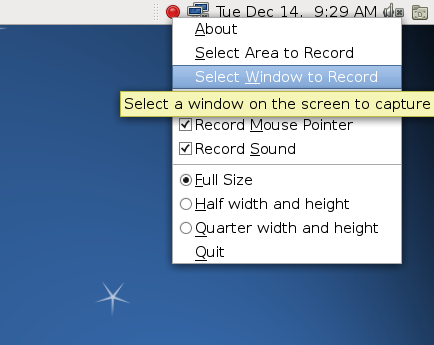
    Istanbul - Istanbul is written in Python and it offers a few less features than recordMyDesktop. It allows to select area or window to record, 3D record, enable/disable mouse pointer recording, and choose the size of the video (full, half or quarter width and height). It saves the file as an Ogg Theora video. Again, I had problems with recording sound, I believe I'm doing something wrong here.

    To install in Ubuntu: sudo apt-get install istanbul

    Istanbul


    Another application to include here would be Wink, a freeware software presentation application with ports for both Linux and Windows. Bear in mind though that Wink is not free software. Wink allows to create presentations, include voice recording, explanatory popup boxes, exporting to Flash video. I should also mention the powerful Xvidcap (GTK) and reKordmydesktop (KDE frontend to recordMyDesktop), which, although they don't seem to be maintained anymore, still offer a good amount of features.

    Have some more? Please share!

    Source URL: https://ashesgarrett.blogspot.com/search/label/Review
    Visit ashes garrett for Daily Updated Hairstyles Collection

6 Best Linux Terminal Applications

    Guake - Quake-style terminal for GNOME
    A Quake-style terminal is a drop-down terminal which can be shown/hidden just like the console in Quake (and most of the first-person shooter games out there), using the press of a key (~ in Quake). Guake is a terminal application written in GTK which uses the F12 keyboard shortcut by default to show or hide it.

    Guake - drop-down console for the GNOME desktop environment

    Guake features transparency, tabs, tray icon, configurable shortcuts, fullscreen mode and allows you to change terminal size, transparency level, appearance, font size and default shell interpreter.
    Homepage


    Terminator - feature-rich terminal emulator
    Terminator is a powerful terminal application written in Java with support for features like tabs, automatic logging, text drag & drop support, find function, split the current tab horizontally or vertically, profiles, appearance settings (transparency and background image, colours), plugins and configurable keyboard shortcuts. All in all, Terminator is one of the most powerful terminal emulators out there.
    Homepage

    With features that make it unique, Terminator is a must-try


    Konsole - KDE default terminal
    Being the default terminal for the K Desktop Environment, Konsole brings usual features like transparency, profiles, notifications, shortcuts, tabs, appearance configuration, but also bookmarks, monitor for silence or activity.
    Homepage

    Powerful enough, Konsole usually fits most KDE users who need a terminal to blend into the environment

    Yakuake - Quake-style terminal for KDE
    Yakuake is the terminal of choice for those who use KDE and like the Quake-style approach. Triggered by F12, Yakuake supports tabs, profiles, transparency, resizing, colour and font size configuration, active tab splitting. A very good alternative to Konsole.
    Homepage

    Yakuake - drop-down terminal for KDE

    GNOME Terminal - GNOME default terminal
    GNOME Terminal ships by default with the GNOME desktop environment and it features profiles, configurable keyboard shortcuts, tabs, fullscreen mode, find function, transparency effects, background image.

    The default GNOME terminal application

    GNOME Terminal allows to configure a profile and change appearance settings (including transparency level, background image, colour scheme or terminal fonts), scrollbar, bell and terminal size.


    Tilda - Another Quake-style terminal
    Tilda is yet another powerful Quake-style terminal written in GTK which uses by default the F1 keyboard shortcut to show/hide it. It features tabs, transparency effects, build-in text and background color schemes, and powerful configuration options. When first started, Tilda will show the configuration window, where you can change behaviour like showing it on taskbar or start it hidden, change the title and the default web browser to open links, change size, position, enable transparency, choose background image and enable animated pulldown, colour schemes, enable/disable thescrollbar, compatibility options and show/hide keybinding (default F1). The animated pulldown looks kind of ugly though (GNOME 2.32 and Tilda 0.9.6). It doesn't seem to include support for changing the console font, maybe I missed it? Otherwise than that, Tilda is a very good alternative to the ones already mentioned.
    Homepage

    Tilda - an alternative drop-down terminal for GNOME users

    Source URL: https://ashesgarrett.blogspot.com/search/label/Review
    Visit ashes garrett for Daily Updated Hairstyles Collection
10 Alternatives to Default Applications in Ubuntu 10.10

    Music player: Rhythmbox (full review here)
    Alternative: Banshee (full review here)
    Banshee is a feature-rich collection-oriented player which includes Internet services, cover manager, smart playlists, Last.fm integration, 10-band equalizer, tray icon, ratings, fullscreen mode, track metadata editor, support for radio and podcasts, plugins and play queue, to list only a part of them. The version which comes in Ubuntu Maverick is 1.8.0, but at the time of writing a new development version, 1.9.0, is available on the official website and can be easily installed using the Banshee daily builds PPA at Launchpad.
    Runners-up: Exaile, Listen, Audacious, gmusicbrowser, Decibel Audio Player, Quod Libet, Foobnix, DeaDBeeF, Sonata, GMPC

    sudo apt-get install banshee


    Movie player: Totem
    Alternative: GNOME MPlayer
    GNOME MPlayer is a GTK frontend to mplayer the popular, cross-platform movie player. GNOME MPlayer is provided by the package gnome-mplayer and can play any file that mplayer supports. It has support for subtitles, playlist, video info, and comes with pretty much enough configuration options.
    Runners-up:

    sudo apt-get install gnome-mplayer


    File manager: Nautilus (full review here)
    Alternative: GNOME Commander
    It was a tough choice between this and PCManFM, and finally decided to go for the twin-panel one although the latter is a good replacement too. GNOME Commander is a twin-panel file manager with features like search for files/folders, horizontal layout, SMB support, keyboard shortcuts, bookmarks. It doesn't seem to integrate context menus for various file formats, for example adding/extracting to/from an archive.
    Runners-up: PCManFM, Thunar, emelFM

    sudo apt-get install gnome-commander


    Web browser: Firefox
    Alternative: Epiphany
    Epiphany is a clean and simple GTK web browser that uses the WebKit layout engine. It includes the usual features like privacy management, bookmarks, tabs, history, fullscreen mode.
    Runners-up:

    sudo apt-get install epiphany-browser


    Word processor: OpenOffice.org Writer
    Alternative: Abiword
    Abiword is for those who need a word processing application, but without the more advanced features the OpenOffice.org Writer includes and also quite lightweight compared to the latter. It provides a simple, easy-to-use interface and has support for the OpenDocument Text format.
    Runners-up:

    sudo apt-get install abiword


    Image viewer: Eye of GNOME
    Alternative: gThumb
    gThumb supports a wide variety of image formats and comes with decent features for an image viewer, like bookmarks, basic editing tools (rotate, convert to other formats, resize), extensions.
    Runners-up: GPicView, GQview, GImageView

    sudo apt-get install gthumb


    Terminal application: GNOME Terminal
    Alternative: Guake
    A few days ago I talked about Yakuake, a KDE Quake-style console application. Well, Guake is its counterpart on the Gnome desktop environment. Guake features transparency effects, keyboard shortcuts (F12 to hide/show the terminal), tray icon, tabs (using the Firefox shortcuts to switch - Ctrl+Page Up and Ctrl+Page Down), configuration options.
    Runners-up:

    sudo apt-get install guake


    Text editor: Gedit
    Alternative: Geany
    Geany is a very powerful text editor which also offers features for programmers. Geany comes with tabbed support, highlighting for various programming languages, indentation support, projects, plugins and a whole range of configuration options. A respectable replacement for Gedit, and also a valid tool among more advanced IDEs like Emacs.
    Runners-up: Scribes, SciTE, Leafpad

    sudo apt-get install geany


    Photo manager: Shotwell
    Alternative: F-Spot
    What better alternative for Shotwell than the former default photo manager, F-Spot? F-Spot features camera support, importing and exporting images to various services, tags, extensions to name a few.
    Runners-up:

    sudo apt-get install f-spot


    Email client: Evolution
    Alternative: Claws Mail
    Claws Mail is a highly configurable email client written in GTK with features like address book, support for POP3 or SMTP protocols, external editor, multiple accounts.
    Runners-up: Thunderbird (not GTK but integrates well enough)

    sudo apt-get install claws-mail


    Final notice
    All the alternative applications and runners-up were chosen to blend well in the GNOME environment, which means all of them (except for Thunderbird) are GTK-based.
    Source URL: https://ashesgarrett.blogspot.com/search/label/Review
    Visit ashes garrett for Daily Updated Hairstyles Collection
16 Music Players for Linux

    Linux came a long way concerning music players in the last couple of years and if in the past there were only few choices for users - XMMS has to be mentioned here - well, now there are so many players to choose from, and if most share the same features, each one provides an alternative by bringing a new feature or a different interface. This I can tell, can satisfy any user's taste. Without further ado, here are no less than 16 graphical music players for Linux.

    Each player (except for the last two) have been reviewed before here at TuxArena and there is a link to the review after the application's name.

    Amarok - full review
    I don't think Amarok needs an introduction. Every long-time KDE user tested it at least once, and most of KDE users use it as their primary music player, not to mention it comes by default in distributions like Kubuntu, the KDE-based branch of Ubuntu. Amarok is a powerful, collection-oriented player, with an interface which, although loved by some and contested by others, looks very good and offers as much information as it could. It comes with dynamic playlist support, cover manager, Internet services, Last.fm integration, scripting support, Internet radio support, media devices support and much, much more.
    Homepage

    Amarok - one of the most popular and powerful music players on Linux

    Rhythmbox - full review
    Rhythmbox is the default audio player in Gnome and Ubuntu implicitly. Among the top features it comes with are the music library, sortable playlists, plugins, local file cover support, Last.fm integration, support for services like Jamendo or Magnatune. Another feature of Rhythmbox is the integration with Ubuntu One Music Store, the service provided by Canonical, the company behind Ubuntu (I don't know if this is Ubuntu-specific only though).
    Homepage

    Rhythmbox is the default audio player in Gnome


    Banshee - full review
    Some would recommend Banshee as the first option for replacing Rhythmbox. Banshee integrates in Gnome and it comes with a full set of features, offering a media library, 10-band equalizer, Last.fm integration, cover fetching, playlist support, podcasts and a whole bunch of plugins . Banshee also offers a video library and support for playing movies and video formats. Its only problem seems to be stability though, I had some problems with random crashes and fetching local covers doesn't seem to work (Ubuntu 10.10 and Banshee 1.8.0).
    Homepage

    Banshee is a full-featured player which also includes video capabilities

    Audacious - full review
    This is the GTK2 replacement for the now deprecated XMMS. It comes with Winamp 2.x skin support, an interface which resembles the Winamp 2 look and feel, support for covers, an equalizer, and more. Version 2.4 offers two view modes available in the View menu: Gtk interface and the Winamp Classic interface (screenshots below).
    Homepage

    Audacious is a replacement for XMMS which offers two view modes: Gtk and Winamp Classic


    Clementine - full review
    For those who complain about the direction Amarok 2 took, Clementine can be a very good alternative to Amarok 1.4. Clementine's goal is a port of Amarok 1.4 to KDE4, and until now it's done a good job. Some of the many features of Amarok 1.4 are not yet implemented, but still Clementine offers sortable playlists, cover manager, equalizer, collection manager, file manager, Last.fm song submission. It still lacks support for scripts though.
    Homepage #1
    Homepage #2

    Clementine aims to be the KDE4 port of Amarok 1.4 and does a pretty good job

    Qmmp - full review
    I was talking about Audacious being the GTK replacement of XMMS. Well, Qmmp is the Qt replacement for it, making it perfect for KDE users. It resembles the XMMS interface, supports Winamp 2.x skins, it allows plugins.
    Homepage #1
    Homepage #2

    Qmmp - the KDE replacement of XMMS

    Listen - full review
    Listen is another player for Gnome, and it comes with a clean, well-organised interface as well as support for plugins, Last.fm integration, four display modes (small, normal, full and party mode), lyrics fetching, Wikipedia integration for artist and song info.
    Homepage

    Listen - typical player for Gnome, featuring a well-organised interface

    Exaile - full review
    Yet another GTK application, Exaile features music collection, lyrics fetching, file browser, radio support, sortable playlist, device manager, 10-band equalizer, queue, covers support. Exaile is also highly configurable via the Edit -> Preferences menu.
    Homepage

    Exaile is a feature-rich GTK player offering a good alternative to Rhythmbox or Banshee

    Jajuk - full review
    Well, when I reviewed Jajuk I was really impressed by this audio player. Jajuk is written in Java and it is a full-featured, top notch player with a neat and intuitive interface. Among the many features of Jajuk there are cover fetching, lyrics, file browser, lots of configuration options, statistics, cover manager, highly configurable interface. In my opinion, a must-try.
    Homepage

    Written in Java, Jajuk is a feature-full player


    Decibel Audio Player - full review
    Decibel can be described in one word: minimalist. Written in GTK and aiming to stay simple and intuitive, Decibel can look too simple at first, but don't be confused by that. It still offers enough features one would expect from an audio player and most of Decibel's features are available via plugins (bundled by default in it), so go to Edit->Preferences if you want to take advantage of all the features. It has three view modes (full, playlist, mini), cover fetching support, Last.fm song submission, equalizer, library, Twitter status update plugin. The interface offers a playlist and a file manager, which shows folders in a tree-view mode. Adding music to the playlist may seem at little confusing at first, you can do that by selecting a folder in the combo box to the left of the main window.
    Homepage

    Decibel can be extended using the plugins included by default

    Quod Libet - full review
    Another player for Gnome with standard features and a clean, good-looking interface and support for Ogg Vorbis, FLAC, MP3, MP4, WAV and WMA formats. Quod Libet offers filters, a whole bunch of plugins (actually the plugins extend Quod Libet's functionality a lot, and there are a lot of them), several view modes.
    Homepage

    Quod Libet

    Guayadeque - full review
    I featured Guayadeque in my Linux applications with peculiar names article, and found out in the mean time that Guayadeque is a place in Canary Islands. Guayadeque brings nice features also taking a different approach regarding its interface. Features: radio, Last.fm integration, music library, lyrics, dynamic playlists, podcasts support, file browser, ratings. I think Guayadeque does a great job taking a different approach then most of the players out there.
    Homepage

    Taking a different approach, Guayadeque is a must try if tired of usual players

    Foobnix - full review
    Another player for Linux, Foobnix is written in Python and uses the GTK toolkit. It offers the usual equalizer, Last.fm song submission, an online search tool and enough configuration options. The current version in Ubuntu is a little buggy, but other than that Foobnix is a good audio player.
    Homepage

    Written in PyGTK, Foobnix offers enough features

    Goggles Music Manager - full review
    Goggles Music Manager is written using the FOX toolkit, a library for designing lightweight applications. It features AlbumArt support, tag editing, smart sorting, drag and drop support, Last.fm and Libre.fm song submission, SQLite database for the music collection, system tray integration.
    Homepage

    GMM is a lightweight music player written using FOX toolkit

    JuK
    It looks like most of the players in this review are written in GTK, and those for KDE are only Amarok, Clementine, and JuK. This player offers features like cover manager, history, crossfading or the tag editor. JuK is very good for those who want a lightweight audio player for KDE.
    Homepage

    JuK - a simple KDE player which has been around for years

    DeaDBeeF
    DeaDBeeF is a player coming with a compact interface and features like an equalizer, tray integration, plugins, global hotkeys. Among the notable plugins are the OSD or the AlbumArt plugin.
    Homepage

    DeaDBeeF offers a compact interface and an equalizer

    Except for those, there are the client-server oriented ones, like XMMS2 and MPD (with clients such as Sonata or GMPC - for MPD and the ones listed here - for XMMS2), or text user interface players which can run in a terminal, like CMus (review here), mp3blaster or moc (review here).
    Source URL: https://ashesgarrett.blogspot.com/search/label/Review
    Visit ashes garrett for Daily Updated Hairstyles Collection

Quick Look at 0 A.D. - Free Linux RTS Game

    0 A.D. is an open-source, 3D real time strategy game with an ancient warfare theme, developed by Wildfire Games, and using the Pyrogenesis engine.

    0 A.D. started originally as a mod concept for Age of Empires II, but in 2009 Wildfire Games licensed the code under the GPL and announced it will be open-source, available for Linux, Windows and Mac OS X.


    The game is currently under heavy development, and the latest alpha was released on October 19 2010 (Alpha 2 'Bellerophon') and it currently includes the following features:

    - 3D graphics using OpenGL
    - 1 civilisation units & buildings
    - fog of war
    - group movement and basic unit formations
    - population limits
    - repair command
    - minimap
    - unit following camera mod
    - building rotation keys

    Considering it's still in alpha, the game doesn't have yet an AI opponent, however multiplayer works (the in-game manual explains how to play over Internet). Regarding single-player, you can still try the game to see the current features and adjust to the gameplay.

    The developers didn't fix a date for the final release, but the final game is expected in 2011 or 2012.


    Installation in Ubuntu 10.10 Maverick Meerkat

    To try it in Ubuntu, use the 0 A.D. PPA:

    sudo add-apt-repository ppa:wfg/0ad
    sudo apt-get update
    sudo apt-get install 0ad

    Run the game by typing 0ad in a terminal or press Alt+F2 and type 0ad in the run box that appears.
    Source URL: https://ashesgarrett.blogspot.com/search/label/Review
    Visit ashes garrett for Daily Updated Hairstyles Collection

Blog Archive